Cradle Mountain 2016 Aug Snow camping

Cradle Mountain, camping in the snow.

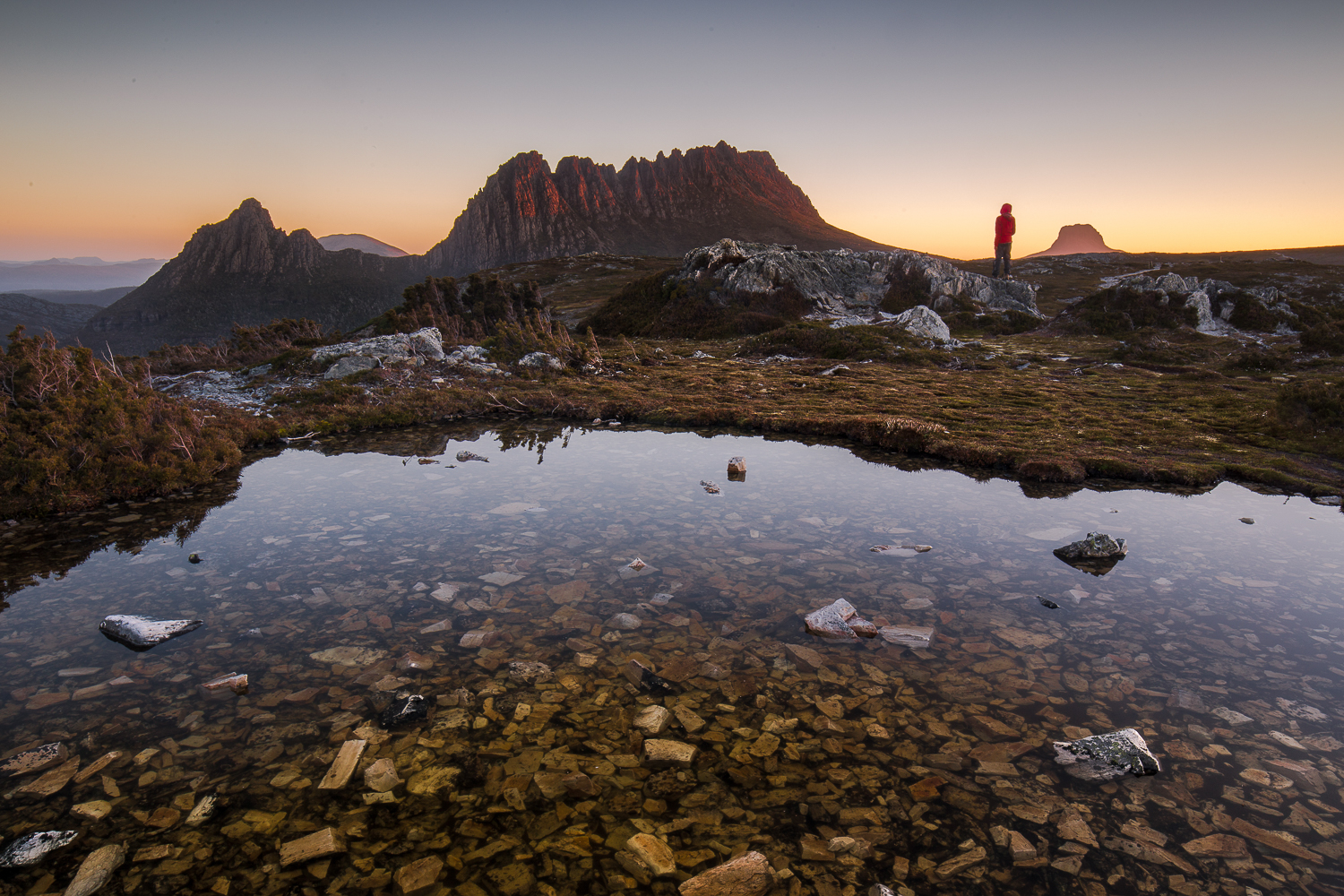
If you have been following this blog, you will know that I have been trying to get out snow camping almost every weekend since I returned from Europe, but that something has always come up to prevent it. At last this weekend I got my wish. Angela had time free and wanted an adventure; snow was predicted: we were off. Initially we were (we thought) going to climb Blue Peaks and be on the Western Tiers, but road access problems meant that we had to choose the Cradle area in order to get both an open road and snow. I wasn’t sad. I love this place, and don’t always need to be somewhere new.

We were both feeling a bit out of practice at Tassie-style snow work, so I also enjoyed being in an area that offered us plenty of dramatic snow and yet was only a couple of hours from the lodge, so somehow that felt less remote if anything went wrong. It was good to have a chance to refine our methodology and test some of our new gear here before committing ourselves to the really deep wild wilderness. Mind you, during the night, with the wind howling and the tent making explosive whiplash noises, I didn’t feel so terribly secure, and kept wondering if I’d survive if the tent broke in one of these furious gusts. Plenty of people have died within five kilometres of Cradle, so it didn’t feel particularly wussy during the night.

I am “naturelover”, so it goes without saying that I love nature: this does not mean some National Parks attenuated idea of nature, some metre-wide levelled out highway through what is dubbed wilderness for the sake of city tourists, but which is tamed with infrastructure to defang it for timid  human toleration. I am not against the existence of such tracks – everyone begins somewhere, and my love of extended bushwalking began with the Overland Track, and it serves a need either as a beginning point, or even an ultimate achievement for many people. However, I think if we really want to meet nature in its supreme form, we need to expose ourselves to some of its less “pretty” and comfortable aspects. A snow storm in winter is one such.

Robert Macfarlane in The Wild Places, a book searching for wild locations in Britain, spends a night in midwinter on a Lake District mountain exposing himself to the fury of a storm in order to experience and appreciate nature’s unleashed force. When I read his book (which I loved) I felt so sorry for the people of the British Isles, that there were so few places where they could experience the might of undiminished nature. We are somewhat spoiled in Tasmania to have reasonably easy access to abundant places that satisfy this longing – but we need to be wary. People who only see nature as the means for making money and who wish to thus subject nature to their concept of what tourists want and who are willing to sacrifice what they neither know nor understand to the great god of dollar are encroaching on the wildness and wilderness we have left and are chomping bits out of it at an alarming rate.

Many, many Tasmanians mourn the loss of the access to wilderness that we used to enjoy in our own national parks as our old freedoms are removed with each new development, for the most part brought in to allow better management of visiting tourists rather than any motive of caring for the land. Our love of this land is being ignored. Our attachment to the land, our sense of spirituality that comes from being in infinite space and beauty, and our culture of camping and walking in it are treated as nugatory. Of course the tourist industry has myriad excellent features, but that does not mean we allow it to run out of control so that the only wild thing left in our state is that government department. Like alcohol, tourism should be used in moderation. I would love to live in a land where values other than money ruled our ethos and regulations. I fear this worship of money above all other values will ultimately bring about the collapse of western civilisation as we know it, for it is fast running out of control in a destructive solipsistic spiral. The object so valued because it can bring so much can also be the object of demise when not controlled.

I thought of Robert Macfarlane during the night of not-all-that-much sleep, and pondered such issues. We cannot respect nature if we don’t know what it is, and if we fail to respect it, we will harm this beautiful earth beyond repair.

For those who have not tried snow camping, but who are already thinking they want to take this step, I will tell you what we wore to bed. One size does not fit all. We are both small, lean females who feel the cold. Our needs will probably not be felt by those with more padding, and will not suffice those with less. This is what I had on to survive the night, and Angela’s story is similar. On my head I had a silk balaclava, an icebreaker buff and the hood of my Arcteryx jacket (as well as the hood of my bag). On my upper body, I had an icebreaker singlet, a long-sleeved thermal top, an icebreaker T-shirt and a cosy Arcteryx jacket, as well as the warmth from my sea-to-summit SpIII goosedown bag (850 loft, 400g fill). My hands were warmed by possum gloves. On my legs, I had thermal longs (over woollen knickers), orienteering pants, another pair of icebreaker wooden long tights and the bag. On my feet I had woolly socks (two pairs would have been nice). Over all of that, I had an SOL bivvy bag (which adds five degrees to what you can tolerate), and over that, my trusty tent. The temperature difference between the other side of that flimsy wall and the protected inside was easy to note. I also had my Goretex jacket spread over my feet area. In my pillow bag, I had another jacket should I need it, and another thermal, but I felt fine. We both used four-season mats. I also had a carpet underlay.
My knees were sometimes a little cold during the night, but as long as the temperature didn’t drop any further, I was fine as I was, and didn’t pull out my reserve gear. I was absolutely definite that I was NOT getting out of that bag to go to the toilet, which I unfortunately needed to do from about 9 p.m. until 7 a.m., but there are some bodily needs that just have to be taught their place. Angela likewise refused her body this request.
Dismantling the tents was probably the least enjoyable part of our excursion, but once we were underway walking again, the pain in our hands soon eased, and I was left wondering exactly how slippery the steep part of the Face Track descent would be. We chose that route as it is the least exposed in our opinion, but still could be challenging in icy conditions where the steel chain is frozen over and the land drops dramatically away over rock that has few vertical holds. We were both carrying minispikes just in case, but, on this occasion, the powdery snow had not melted to make slippery ice, so all was well. And meanwhile, the sight of gums drooping with icy mantels, of filigree branchlets capped in a delicate white covering, of wombats caught unawares whilst burrowing in snow all thrilled me as I scanned the landscape for signs of where a track might be when not masquerading incognito as bland white wilderness. The powdery snow made a delicate sort of squeaking sound as our feet compressed its mass. I wish I could have taken more photos, but I was far too cold, and was having trouble with my camera lens clouding over in these conditions.

Redwater Creek Falls 2016 Aug

Redwater Creek Falls, Upper and Lower, Sheffield area. 2016

Redwater Creek Falls Upper

I had set this weekend aside for snow camping. I have lost count of how many times I have now tried to do this, but something always interferes, and on this occasion, I was thwarted yet again. The webcam at Cradle, which would give me the general idea for anywhere I wanted, showed a dismal, bleak, grey scene that I did not feel like being part of. We opted to make our garden more beautiful by removing weeds on Saturday and to go waterfall chasing and bagging on Sunday. Tessa, our dog, had four votes on this and was happy with the outcome.

The first glimpse of Redwater Creek Falls Lower.

Tessa enthusiastically took her place in the boot of our new 4WD car, thus spreading dirt and hair in a single move and spoiling that beautiful look that we knew all along would be fugacious. Off we set.

The first glimpse of Redwater Creek Falls Lower.

The Tasmania Trail that we followed to the falls is a 460 km long fabulous trail from Devonport (north) to Dover (south), open to equestrians, hikers, bikers but, gloriously, not cars. We decided to do less than the whole length today, but we sure enjoyed the bit that we did. Tessa says we’re allowed to do a lot more next time if we wish.
After walking and photographing here, we then drove back the way we had come until we were 3 kms from Lower Beulah, when we visited the falls below, the Dasher Falls (for directions, see further below). Bruce feared that Tessa might pull on her lead and drag the two of them down the very, very precipitous slope into the cauldron below, so I was the only one who got to see these dramatic falls. I think I saw them under pretty special conditions. They are really worth a winter visit – but not with children.
How to get there: If coming from Launceston,turn left at Elizabeth Town,  just before ETC coming, and then turn right to Railton. After a couple of kilometres, there is a dirt road to right and left. On the right hand side it says it is the Tasman Rail Rd – the former site of a railway line. Turn left up this dirt track and follow it to a gate, where you’ll need to park (plenty of room for that). You then walk along the main track (ignoring alluring side options when they occur). After a kilometre or so, there is a farm-type gate with a walking gate beside. go through the walking gate and continue with a stranded electric fence to your right until, shortly before the next farm gate, you will see another walkers’ gate to your right (the electric cords go overhead). You can see the falls from there. The lower falls are a very short distance indeed from the upper (maybe 20 secs).

Car route and then walking route to Redwater Creek Falls. Starting on the cyan track bottom right, we are driving west in the direction of Sheffield, having set out from Elizabeth Town. When we see the sign to Railton, we head NE along that road. After nearly 2 kms, and on the first possibility, we turn left onto the Tasmanian Trail dirt track.The first waypoint is where we parked at a locked gate. The second waypoint is at the second closed gate. The line actually continues past the falls to the third gate because we just felt like walking there to see what could be seen. Curiosity didn’t kill humans or dog. As said above, the falls are down the only gate in the electric fence off to the right. You can see and hear them from that gate. Hope that helps. These falls are seasonal, so go after rain.


FRANCE Chamonix from north (2) 2016 July

Chamonix, north side of the valley, part 2.

A scene descending from Lac Blanc

My descent from Lac Blanc was slow (for those just popping in to this one blog, my story of the Chamonix region is continuing from previous posts). I was in no hurry to leave – and I wanted the ice to soften to allow me to kick steps in the snow rather than slide perilously down it. I stopped en route to take quite a lot of photos of this lake here, even though the sun was already too high for the sort of photos I favour.

Such a great camping spot!
In another drop and rise manoeuvre, I descended to the Col des Montets and then further, down on the eastern side, to Le Buet, before climbing back up (north) to the Refuge de la Pierre à Bérard, arriving in time for a late lunch. I was so glad I hadn’t brought food with me, as the lunch I ordered was absolutely delicious. I had nothing special I wanted to do before sunset (other than eat more and explore), so I just hung around eating and chatting to the other walkers. Eventually I did manage to leave food, and people, and go and suss out the waterfalls and pay a visit to the Ibex playing in the névé up higher. I had friends up there camped by the snow to chat to later. The afternoon passed quickly.

The descent next day was quick. I was getting quite used to this pattern, and dropped and rose once more to my next lodging for the night, Refuge de Loriaz, where I had some soup for lunch before exploring. Some of the ruins of this ancient alpage date back to 1250. It was very quaint. Dinner later that night was excellent.

Sunset, Loriaz
I slept in a converted animal barn, which I had all to myself, and I loved it. It is off in the shadows to the right of this picture above, too small to be seen properly.

This shot is of dawn, but the evening before, while I was out shooting cows at sunset, they got rather excited to be photographed – famous at long last – and came rushing over to check that I’d taken some flattering images off them, and thought they’d show their love and affection for me by licking the beautiful GND glass in front of my lens. I was in the middle of a long exposure shot that was now being ruined, so I don’t know why I didn’t move earlier. I guess I just expected them to stop. They didn’t. I had cleaning agents for the glass with me, but found that hot water worked better than anything else for this job, so I had to abandon my shooting. They all followed me towards my barn. I am not normally at all afraid of cattle, but they were crowding me out, so I had to act severe and shoo them away lest I get knocked over and trampled in their enthusiasm.

You can see the little barns in this photo

At dawn on this day, I was glad to see that they were a-mooing and a-chewing a bit further away. I no longer thought that cows would make an interesting foreground to the mountains.

After the shoot, I returned to find that the guardian had set up a table outside in the sun for me to have breakfast looking at the mountains. How beautiful. I loved the tranquility of this place.

FRANCE Chamonix from north (1) 2016 June

Chamonix, north side of the Valley, part 1.

Alpen glow to begin a superb day at Bellachat. The weather had been very ordinary the day before climbing up, but this day was perfect. 
 Once it transpired that I needed to escort my sick husband north, I made the seemingly obvious decision to abandon my GR5 quest. Chamonix was en route to Geneva airport, and I know it well. It seemed a perfect location for a new base once Bruce had gone home. I was sure I could devise a wonderful programme of high walking and climbing and photography that would keep me moving and happy. As you can tell from these photos, I really love being high, especially to sleep. Well, I don’t actually like wasting too much time on that. A philosopher I spent quite a bit of time “with”, Immanuel Kant, called sleep “das tote Drittel” [the dead third] and I am inclined to agree with him. On many, many nights this trip, I just didn’t want to waste my time dead to the world when there was so much beauty out the window, so lay there staring at the mountains in the moonlight (or starlight) until sleep crept up on me unawares.
I was so excited when an Ibex came and photobombed my shot aimed at Mont Blanc. We are dealing with exposures of up to five seconds here, and this marvellous animal understood that she needed to be very still for me.

My first choice of mountain hut was Bellachat on the northern side of the Chamonix valley, high above the town and looking directly across at Mont Blanc. We must have been around about 1100 ms above Chamonix, as whenever the French told me Abels were unimpressive pimples, I told them that if Chamonix was the ocean, they were now on an Abel. If they thought they were high, then our Abels have the same feeling. I find the notion of judging a mountain’s worth by its height to be nearly as nonsensical as judging people by the size of their bank accounts. In fact, if I’m looking for nice people, I’d go directly to the opposite if I want to increase my chances of finding what I want.

It is not at all necessary to drop down to Chamonix to get from where I was to my next destination, Lac Blanc, but I am not in the mountains to be efficient. I enjoy exercise, and did not intend spending the time between dawn and dusk (the two times I love) being idle, so I descended to Chamonix, then went to Argentière and gained all my height back again and a bit more. The climb up to the lake was in full snow that looked rather forbiddingly steep from afar, but was fine in reality. Things always look worse than they are from afar, I find.

My glorious path leading downwards …


which eventually dropped below the clouds, giving me a magical mist to walk in.
The slope off to the side is a little steep.
How I love Lac Blanc

Lac Blanc was as beautiful as ever. I sat on a rock just staring at the majesty for over an hour, waiting for dinner time. In that time, a man approached who looked oddly like my husband did before his disease changed his posture and gait. His hair was wild, bushwhacker hair, like Bruce’s of yesteryear, and he seemed to stride towards me with purpose. Absurdly (seeing’s he was then on a plane to Australia), I thought: “Ah, here comes Bruce to meet me.” My heart leapt for joy, until reality crashed into me, and I sobbed. He will never come to meet me with a bounce like that, or in the wild again.

The beauty of the white snow with steely blue patches helped soothe me in this nasty rubbing of my nose in the state of things as they actually are. In the quiet and majesty of the mountains I find it easier than anywhere else to find peace.

The following night I would spend at a hut in the next valley to the east, but to get there, I would drop all the way down to the main Chamonix valley yet again, and climb back up, as there is no direct route connecting both locations, and, even if there were, I would possibly not use it, as that would make the day too short, and I wanted both a decent workout and to sleep in that particular valley.

A new day dawns. This world is breathtakingly, poignantly beautiful.
The next post will deal with the next two valleys on the northern side before I move my attentions south.

FRANCE GR5 2016 Modane to Briancon

FRANCE GR5 2016 Modane to Briancon

South of Modane, high in the mountains near Col du Thabor

The tale of the GR5 this year is one of goals abandoned rather than mission achieved. I am not sad about this. I had only ever said I wanted to make Nice if Bruce was happy about the venture and if the scenery remained beautiful. I could see no point in continuing if we didn’t appreciate the landscape around us, and if Bruce wasn’t happy, it would not be right to inflict torture.

He began well enough, after a more than shaky start in England. I always use the week in England as a kind of acclimatisation period for him, in which he supposedly increases his amount of exercise each day as the fatigue and stress of work are gradually shed. This year, there was no shedding, and no increase of exercise. The only thing that grew was his anxiety about being away from the place where things are familiar – an unfortunately frequent symptom in his illness that has not invaded him up to this point but which is mushrooming now. He slept a lot in England, so I just kind of hoped that the resulting rest would mean he’d be nice and fresh for the task of France.

 He started very well for the first hour, but then began asking: “How far now?”, a bad sign that many parents of young children will recognise immediately. I encouraged and cajoled and eventually he made it. As you can see from my images, this was a very beautiful place, with heaps of wonderfully photogenic snow. He was not happy walking on snow, and after dinner went straight to sleep while I explored and took the above photos.

In the morning he slept through my dawn shoot (in all other trips, he has accompanied me, to share the beauty even if not to photograph it). He said at breakfast, however, that he wanted to walk the route I had planned – my Plan A of many – so off we set after we’d eaten (hut breakfasts are not to die for), dropping down sharply before climbing up very steeply indeed to another col, and finally descending to Plampinet, where we arrived for a mildly late lunch, our day’s work done. Apart from a single incident where he was obviously geographically confused, he appeared to be going very well, ate his delicious omelette with gusto and joined me exploring the two churches (two of about ten buildings in this whole quaint place built of stone), one of which dated back to 1450 and was having its bell repaired : Chapelle Notre-Dame-des-Grâces de Plampinet.
Later on, he said he was exhausted, so I arranged for him to catch a bus to my next destination, Briancon, while I went high into the mountains and over three cols to drop down and join him. He was happy with this. I took him to the bus stop, wrote notes for him about where to go, what to ask for, and everything was fine. All the other walkers had meanwhile changed plans and abandoned going high, as they were frightened of the thunderstorms that had been predicted for this day.  They would walk along the valley floor, following the beautiful river to Briancon and avoid all climb. However, I was here to be in the mountains, not to make destinations per se, so I set off into the mist alone. For me, seeing the kind of scenery I wanted was more important than saying: “I have walked from Lac Leman to Nice”. The others kindly said Bruce could go with them, but he doesn’t deal well with changes of plans, and was happy with the one we’d set in motion. He carried it all out well, and at the end of a truly wonderful long morning where a storm did surround me but didn’t drench me, and certainly didn’t kill me, I met him at the Gîte d’etape in Briancon. This was a fascinating town with dried out moat, old cobbled streets about the width of two donkeys and a great feel to it.

Bruce underway on day 2.
When there, I discussed with the Tourist Bureau how Bruce could get to my end point for the following day, Brunicard. He nodded with approval at our plan, but half an hour later said he had never heard that conversation and knew nothing about what we’d agreed to. Meanwhile, he couldn’t walk. I could tell he’d been sleeping for much of the morning, which was not an encouraging sign. He was obviously not comfortable with what I’d planned for him this next day, despite my offer to go with him to the starting point of his vehicular journey. 
One of my cols on day 3

I asked was there anything we could do that would please him, anywhere where we could go – even if far away from here. No to both. Would he like to go home? Yes. So while he slept during the night, I typed away to my amazing travel agent, Gary Woodland from Andrew Jones Travel. Meanwhile, the gardien from our refuge (Gîte Le petit Phoque) had driven us down to the bus stop so we could check everything out and make sure we had the timetable right, an incredibly kind gesture. By 5 a.m. there was an email from Gary. Please confirm quickly. I have Bruce on a plane out of Geneva in two days’ time. Cost for change, $85. How amazing is that? Confirmed immediately, of course. By the time Bruce woke up, I could tell him the new plan. We’d catch a bus to Chamonix and he would be nice and near Geneva to fly out.

It was a bit stormy up top.
Thus, next morning off we set on his homeward journey. Sad to change my goals? Only a little. As said at the start, they were always subservient to other, higher ones. The really sad part is that I presume that is it, our last ever trip. He was ill at ease the whole time, even in England, and his is a degenerative illness, so that is the end of a chapter in our lives: travelling together. We have travelled the world together since we were teenagers. He was always a great adventurer, keen to see new places, discover new things, and fit and strong enough to carry out the most bizarre of plans. Now this disease has corroded his spirit and left him in a state where travel no longer pleases.
Another sad part of abandoning the GR5 (as opposed to abandoning travelling with my husband) was saying ‘Goodbye’ to all the lovely new friends I’d made already along the track, people who would continue on without me. We said our fond farewells, and, funnily, they thanked me for what I do for my husband. This is excessively rare for me – so rare it made me cry. Living with us for three days, they could see how things were.
The next stage of my journey, and your next lot of photos, will be from Chamonix.